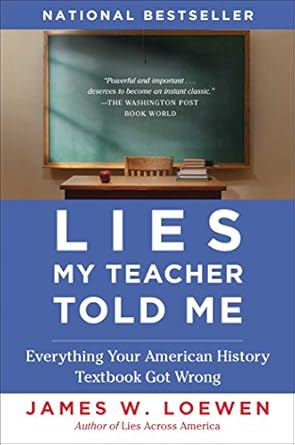

Title: Lies My Teacher Told Me
Author: James W. Loewen
Genre: Nonfiction, History
Rating: ★★★☆☆
Why I read it: I’m on a quest to learn as much as I can and this seemed interesting
Lies My Teacher Told Me is exactly what it sounds like – a book that talks about all of the lies that your teachers (may have) told you in your years of history classes. It is an academic work, covering topics that range from Christopher Columbus to the events of 9/11, that forces the reader to challenge what they were taught years and years ago. I read the second edition of this book, released in 2007, therefore it was important to keep that at the forefront of my mind. 2007 was eighteen years ago (much to my dismay), and a lot can change in that time frame.
Lies claims to be nonpartisan in its description, and at times, it is. Others, it obviously favored one party line over another. Which, frankly, was a good reminder that this isn’t a primary source of material, or even a secondary source, but rather a tertiary source founded on the opinions of one college professor and his research. Is there interesting information in this book, absolutely! Did it need to be 362 pages? I don’t think so. Somehow, for a book attempting to cover the numerous lies told during a child’s educational journey, it felt too repetitive – some topics were covered on the surface, while others felt like they were being overdone.
I did learn quite a few things that I think I knew subconsciously, but it was helpful to hear them in a new context. First, the textbooks you are provided in school are so politicized that they are boring. Not wanting to upset either side of the aisle, textbooks water down the material, thus creating an unengaging environment for students. Additionally, not all textbooks were created equal! It was a bit shocking to hear that what is covered in textbooks is largely based on lobbying, but after sitting with that fact for a while, it really isn’t that shocking after all. What in our lives isn’t heavily influenced by lobbying these days? Regardless of your political affiliation, you can acknowledge that a history textbook cannot cover every nuance, lest it be insanely large. Because of that, lobbying and political interest play a part in the editorial choices of these texts. This book attempts to explain why some of those choices were made.
The author draws attention to many historical events and the differences in what textbook materials cover versus what citizens experienced in real life during that time. Without taking the time to research every source this author has cited (or supplement with my research), it is hard to say if the things asserted in this book are the “true” condition. It is mentioned in the book repeatedly that history is largely based on interpretation, and this book is just one interpretation, much like our textbooks are another. I set out to read this book to gain additional context into the world around me, and I definitely got that, and now I want to take a history class because I have so many more questions.
Full disclosure, I read about 25% of this book in physical form, and the other 75% I listened via audiobook. This material is dense, and at times, it’s rather difficult to get through. Listening to the audio book allowed me to approach the book like a podcast, which kept me engaged. I missed out on supplemental information, such as diagrams, excerpts, and citations, present in the physical book. Should you decide to go the audiobook route, please heed my warning.
Below are some interesting quotes from the end of the book, where all of the meat is.
Page 337: “Parents may feel undermined when children get tools of information and inquiry not available to adults and use them in ways that seem to threaten adult-held values…Perhaps adults’ biggest reason for lying is that they fear our history – fear that it isn’t so wonderful and that if children were to learn what has really gone on, they would lose all respect for our society.” This quote is particularly interesting in the context of today’s society. The author goes on to cite a study from the late 90s that reveals that students during that time were sure that the United States’ best years were behind us. I would venture to say that that hasn’t changed much today. With the access students have to the internet these days, I’d be willing to wager that this has only gotten worse.
Page 342: “If knowledge is power, ignorance cannot be bliss.” Well, it can’t get much more profound than that.
Page 352: “Audiences would not be so easily fooled if they would only recall that educated people were and are more likely to be Republicans, while high school dropouts are more likely to be Democrats.” This one had me stopping in my tracks. This is not the impression I have of society today, so I did some supplemental digging. The author cites The Pew Research Center quite a bit throughout this book and does so when making this assertion. He’s not wrong, at the time of publishing, this statement was very much the truth. However, using the same source, updated to include data through 2023, the opposite is true today. According to The Pew Research Center, “…the Democratic Party has a 13-point advantage (55% vs. 42%) among those with a bachelor’s degree or more formal education. This pattern is relatively recent. In fact, until about two decades ago the Republican Party fared better among college graduates and worse among those without a college degree.”
All in all, I’m rating this three stars for a few reasons. First, it was repetitive, and a bit boring (how ironic), and the only way I could finish it was by listening to the audiobook. Second, I wish it covered more topics versus continually harping on the same ones in different fashions. The best part of the book was the last two chapters and the afterword, which totaled 61 of the 362 pages (16%). I did learn a lot, and there were times I was truly locked in, so for those reasons, it was a middle-of-the-road book for me. I’m glad I read it and I look forward to continuing to educate myself on these topics.
TL;DR: Would I recommend it to a friend? Maybe. If someone is interested in hearing a different perspective from what they learned in school and will use this as a jumping-off point for further research, then it’s a great fit. This book doesn’t have all the answers, but it does an excellent job of challenging the reader to form their own opinions and question everything they thought was a given fact about America’s history.

 Home
Home 
Leave a comment