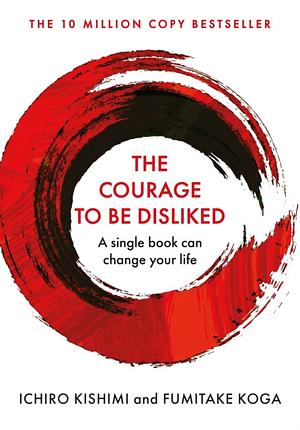
Title: The Courage to Be Disliked
Author: Ichiro Kishimi, Fumitake Koga
Genre: Nonfiction, Self Help
Rating: ★★☆☆☆
Why I read it: To overcome my fear of being disliked by others
The Courage to Be Disliked follows a discussion between a philosopher and a young man, where the philosopher imparts the wisdom of Alfred Adler, one of the three giants of nineteenth-century psychology. Through structured dialogue, the young student challenges the philosopher to better understand how he can determine the direction of his life, free from the expectations of others.
I put it on hold at the library months ago after seeing a TikTok, as something I have been trying to work on in recent years is releasing my desire for likability and fear of being disliked by others. As a recovering people-pleaser, this book seemed like the quick fix I needed to keep me from continuing to hold myself back from my goals. Boy, was I surprised upon opening the cover to find a dialogue format.
At first, I appreciated the dialogue format. It was an interesting concept and made for a unique way to consume self-help material. By the end of the book, I felt it was a barrier to my true understanding of the lessons and I wished it was presented in a more straightforward approach. I am no stranger to self-help books, and I will say that this one by far was the fastest-paced I’ve ever read. I attribute this mainly to the format, but it’s more likely due to the actual lack of content presented. At times it felt like we were going around and around in circles and I could have sworn we covered something before, only to look back and realize it was the same thing just presented in a slightly different way.
Speaking of actual content, the lessons the philosopher was teaching didn’t connect to me, and I found myself disagreeing numerous times with the principles presented. I didn’t love the sentiment that trauma isn’t real, and I especially didn’t enjoy the exchange in the later half of the book that insinuated that the reason why no one wants to help with the dishes is because the one doing the dishes is going about it negatively, and if they would just hum while they did them, others would be inclined to help. Like, come on. I understand that one’s energy can alter another’s perception of the situation, but this just feels sexist. I imagine that any woman who has ever been told to “smile” before recognizes this feeling.
Because I didn’t agree with a lot of the “advice” given in the book, and, quite frankly, found the young man to be annoying (why was he so angry?), I did a lot of skimming. I was rapidly turning the pages trying to find something, anything, worth holding on to. I did manage to pull out a few things that resonated, and, when taken out of the context of the book, are actually pretty solid pieces of advice, even if it’s a bit familiar and surely have been shared before.
- It is best to focus on what you can make of the equipment (skills, circumstances) that you have, versus focusing on what others have that you wish you could adopt for yourself. In the same breath, it’s best to refrain from measuring yourself or your progress using someone else’s yardstick.
- “If you are not living your life for yourself, then who is going to live it for you? … When one seeks recognition from others, and concerns oneself only when how one is judged by others, in the end, one is living other people’s lives.” The whole book could have just been these two sentences and saved everyone a lot of time and confusion.
- Have the courage to be normal. You needn’t be stressed trying to always be the “best of the best” – there is a lot of peace to be realized with the acceptance that “normal” is a courageous way of life. As a former high-achieving “gifted” kid in school, I struggled a lot with the concept of being normal after leaving that environment and no longer feeling the pressure of being perfect.
- “You set objectives for the distant future, and think of now as your preparatory period. You think, I really want to do this, and I’ll do it when the time comes. This is a way of living that postpones life. As long as we postpone life, we can never go anywhere and will pass our days only one after the next in dull monotony.” Point blank, period. Live for the now or your days will pass you by. The goal to get to the top of the mountain isn’t life, it’s the journey along the way that makes life worth living.
If it wasn’t obvious already, I gave this book two stars because there just wasn’t much to it. When you connect more to the afterword of the book than the actual content, that’s a pretty big miss. Maybe I set too high of expectations, or maybe I’m “too healed,” if there is such a thing. Going into it, I expected a certain level of ground-breaking revelation and it just didn’t deliver. For some, this may be exactly what they need, but it just didn’t do it for me and I felt it lacked depth. It’s spared a one-star review because there were some pieces of wisdom worth walking away with, but at the end of the day, I can sum it up in one word: disappointing.
TL;DR: Would I recommend it to a friend? No. You’re better off going to therapy or reading a number of other titles on the topic.

 Home
Home 
Leave a comment